

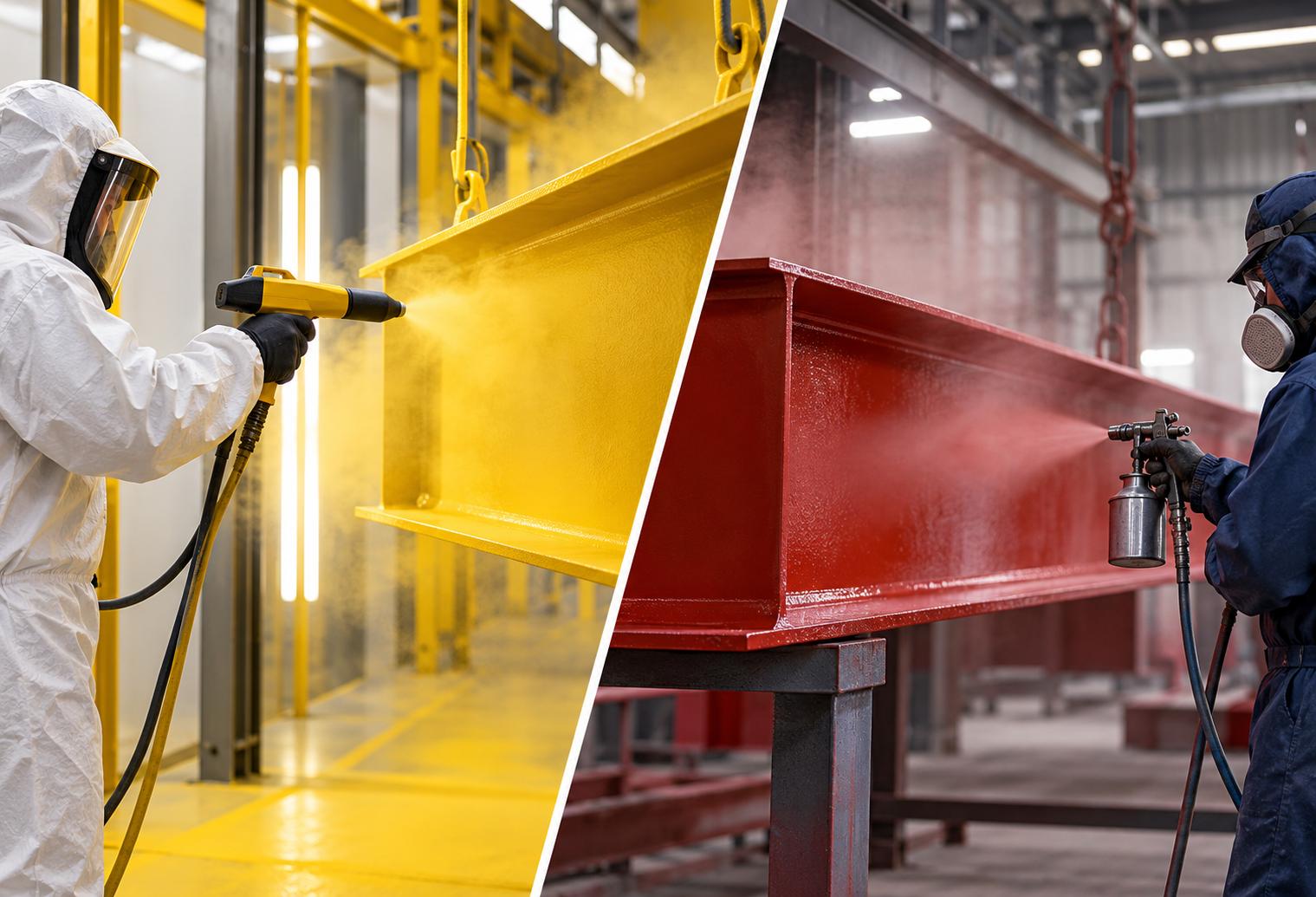
Industrial steel surfaces take a beating in New Hampshire. Equipment, railings, structural components, machinery, and other metal surfaces may face regular handling, abrasion, moisture, temperature swings, and the demands of busy commercial or industrial environments. When those surfaces need refinishing, choosing between electrostatic painting and traditional spray painting can affect application efficiency, overspray, disruption, and the finished result.
Quick answer: Electrostatic painting uses an electrical charge to attract specially applied coating particles to a grounded metal surface, while traditional spray painting relies primarily on air pressure or other spray equipment to deliver coating onto the surface. For industrial steel, electrostatic application can provide efficient coating transfer and help reduce overspray, particularly on appropriately prepared conductive metal surfaces.
What local facility managers and property owners should know
-
Electrostatic painting is particularly well suited to conductive metal surfaces such as steel.
-
Traditional spray painting remains useful for surfaces, coatings, or situations where electrostatic application is not appropriate.
-
Electrostatic attraction can help coating reach around certain edges and contours of metal components.
-
Surface preparation is critical with either method, especially where New Hampshire moisture, winter conditions, or previous coating failure have contributed to rust.
-
The best application method depends on the steel surface, its condition, the coating system, accessibility, and the surrounding work environment.
Why Does the Painting Method Matter for Industrial Steel in Auburn, NH?
The painting method matters for industrial steel because the application process influences coating transfer, overspray, coverage, and how easily work can be performed around an active facility. In Auburn, NH, those considerations can be especially relevant for businesses trying to maintain steel assets without creating unnecessary disruption.
Southern New Hampshire experiences substantial seasonal changes. Steel components may encounter summer humidity, rain, winter moisture, road salt tracked into facilities, and temperature fluctuations throughout the year. Interior industrial steel can also face wear from equipment, carts, tools, cleaning procedures, and routine operations.
Facilities around Auburn and neighboring communities such as Manchester, Hooksett, Candia, Chester, and Londonderry may contain everything from steel railings and lockers to machinery and production equipment.
ARC Electrostatic Painting serves customers looking for painting solutions for appropriate metal surfaces. When evaluating a project, we consider the condition and configuration of the surface as well as the practical demands of the space before determining an appropriate application approach.
How Does Electrostatic Painting Work on Steel?
Electrostatic painting works by electrically charging coating particles so they are attracted to an oppositely charged or grounded conductive surface. Because steel conducts electricity, properly prepared steel components can be strong candidates for this application method.
The attraction between the coating and metal helps direct material toward the target rather than allowing as much airborne coating to travel beyond it. On suitable objects, electrostatic attraction can also create a wraparound effect that helps coating reach edges and portions of the surface that do not directly face the spray gun.
That does not eliminate the need for careful technique. Geometry, grounding, surface preparation, coating selection, and access still affect the finished result.
What Do We Commonly See With Industrial Steel in Southern New Hampshire?
Industrial steel in Southern New Hampshire can experience coating wear, corrosion, scratches, impact damage, and deterioration associated with moisture and normal facility use. These are practical field conditions rather than claims about every steel surface in the region.
In facilities around Rockingham County and the greater Manchester area, the condition of painted steel can vary significantly depending on whether the component is indoors or outdoors, how frequently it is handled, whether chemicals or cleaners contact it, and how well previous coatings were maintained.
For this reason, choosing an application method should come after evaluating the actual steel and existing finish rather than simply choosing whichever process sounds more advanced.
What Are the Main Benefits of Electrostatic Painting for Industrial Steel?
Electrostatic painting can improve coating-transfer efficiency and reduce unwanted overspray when used on suitable conductive metal surfaces. This can make it particularly useful for certain industrial steel refinishing projects where surrounding equipment, walls, floors, or work areas need to be considered.
The process can also be useful for steel objects with multiple sides, curves, edges, or detailed shapes. Electrostatic attraction helps draw coating toward the grounded metal instead of relying solely on the direction of the spray.
For an Auburn facility that cannot simply empty an entire work area for an extended period, controlling the application process can be an important project consideration.
What Warning Signs Suggest Industrial Steel Needs Refinishing?
Industrial steel may need professional evaluation when its existing coating is no longer providing consistent coverage or the underlying metal is beginning to deteriorate. Facility managers in Auburn, NH should periodically inspect frequently used and moisture-exposed metal components.
Watch for:
-
Rust appearing through the existing coating.
-
Peeling, flaking, or lifting paint.
-
Bare steel exposed by scratches or impacts.
-
Significant fading or inconsistent appearance.
-
Worn areas on frequently touched railings, cabinets, or equipment.
-
Bubbling or blistering in an existing finish.
-
Coating deterioration around joints, edges, corners, or fasteners.
-
Repeated touch-ups that no longer produce a consistent finish.
Catching deterioration early may make it easier to address the coating before corrosion becomes more extensive.
When Should You Call a Professional About Painted Industrial Steel?
A professional should evaluate industrial steel when corrosion, coating failure, difficult access, large surface areas, or an active work environment make refinishing more complicated than routine touch-up work. Professional evaluation is also appropriate when electrostatic equipment and specialized application procedures are being considered.
Facility personnel can safely monitor painted surfaces for scratches, rust, peeling, and general wear. They can also document which areas deteriorate fastest.
Preparation and refinishing become more complicated when rust is established, previous coatings are failing, nearby property requires protection, or the work involves machinery and other operational assets. Those conditions are good reasons to discuss the project with an experienced painting professional.
What Commonly Causes Industrial Steel Coatings to Fail?
Industrial steel coatings commonly deteriorate because of moisture, inadequate surface preparation, physical wear, contamination, or age. Around Auburn and the rest of southern New Hampshire, seasonal moisture and winter-related conditions can add to the stresses already created by normal commercial use.
Moisture and corrosion: Water reaching exposed steel can contribute to rust beneath or around a damaged coating.
Impact and abrasion: Carts, equipment, tools, products, and routine handling can scratch or wear through painted surfaces.
Poor surface preparation: Applying a new finish over contamination, loose coating, or improperly prepared steel can compromise the new application.
Chemical exposure: Cleaners, oils, solvents, and other substances used in industrial settings can affect certain coating systems.
Aging coatings: Even a well-applied finish can eventually show wear based on exposure and use.
How Can Auburn Businesses Maintain Painted Steel?
Auburn businesses can extend the useful condition of painted industrial steel by keeping surfaces clean, watching for coating damage, and addressing exposed metal before corrosion spreads. Maintenance should focus particularly on high-contact areas and surfaces exposed to moisture.
Routine visual inspections are a practical starting point. Look closely at corners, edges, welded areas, bases of equipment, and places where objects regularly strike or rub against the steel.
After New Hampshire’s wet or winter seasons, exterior and entry-area metal deserve additional attention. Road salt, moisture, and debris can be carried into commercial properties and collect around steel components.
Small maintenance issues may be manageable internally depending on the surface. Extensive rust, widespread coating failure, or complete refinishing is better evaluated professionally.
What Results Can You Expect From Professional Steel Refinishing?
Professional steel refinishing should leave an appropriately prepared surface with a more consistent protective and visual finish, although the exact result depends on the steel’s starting condition, coating system, preparation, and application method. Electrostatic painting is one option for achieving controlled application on suitable conductive metal.
Refinishing can improve the appearance of worn industrial assets while providing a renewed coating over properly prepared steel.
It is important to set expectations based on the individual project. Severely damaged, corroded, or physically deteriorated components may require repairs or replacement in addition to painting.
What Mistakes Should Businesses Avoid When Repainting Industrial Steel?
The most common mistakes involve treating painting as a cosmetic step rather than a complete surface-preparation and coating process. That can lead to disappointing results regardless of whether traditional spray or electrostatic application is used.
Mistake: Painting directly over rust or loose coating.
Consequence: The new finish depends on an unstable underlying surface.
Better approach: Address surface condition and preparation before applying the new coating.
Mistake: Assuming electrostatic painting works for every surface.
Consequence: The process may be chosen where another application method makes more sense.
Better approach: Evaluate conductivity, geometry, coating requirements, and jobsite conditions first.
Mistake: Focusing only on color.
Consequence: Important considerations such as preparation, coating compatibility, and exposure can be overlooked.
Better approach: Treat appearance as one part of the overall refinishing decision.
Mistake: Waiting until corrosion is widespread.
Consequence: The scope of preparation or repair may become more substantial.
Better approach: Inspect steel periodically and respond to early signs of coating failure.
What Is a Common Industrial Steel Refinishing Scenario in Auburn?
A common local scenario is an Auburn-area facility with steel equipment, cabinets, railings, or other metal components that remain functional but have become scratched, faded, or worn. Replacing those components solely because of their appearance may not always be the first option worth considering.
A professional can evaluate the existing finish, underlying steel, surrounding workspace, and intended use. If the surface is an appropriate candidate, electrostatic painting may offer a practical refinishing approach. In other circumstances, conventional application methods may be preferable.
This is a representative scenario, not a specific ARC Electrostatic Painting project or customer case study.
Which Painting Services Can Address Worn Industrial Steel?
Professional metal painting services can address industrial steel that needs surface preparation and a renewed coating, with electrostatic or conventional spray application selected according to the project. The correct service depends on the material, current condition, location, geometry, and coating requirements.
Electrostatic painting is especially relevant when the object is conductive and the project can benefit from the attraction between the coating and grounded metal. Traditional spraying remains a versatile option where electrostatic application does not fit the substrate or project conditions.
How Does Electrostatic Painting Compare With Traditional Spray Painting?
Electrostatic painting differs from traditional spray painting primarily in how coating is directed toward the target surface. Traditional spraying propels coating from the applicator toward the object, while electrostatic equipment adds an electrical charge that helps attract the coating to grounded conductive material.
| Consideration | Electrostatic Painting | Traditional Spray Painting |
|---|---|---|
| Best suited for | Conductive surfaces such as steel | A broader range of suitable substrates |
| Coating attraction | Electrically attracted to grounded surface | Primarily directed by spray pattern |
| Overspray control | Can reduce overspray on suitable projects | Requires careful spray control and masking |
| Complex metal shapes | Wraparound effect can assist with certain shapes | Coverage depends more heavily on spray angle and access |
| Project selection | Requires suitable conductivity and grounding | Useful across many conventional painting situations |
| Surface preparation | Essential | Essential |
Neither method eliminates the fundamentals of a successful coating project. Surface condition, preparation, coating compatibility, application skill, and the service environment all remain important.
Where Do We Provide Industrial Painting Services?
Our Auburn, NH location places us in southern New Hampshire near communities such as Manchester, Hooksett, Candia, Chester, and Londonderry. Project availability and service coverage can vary by location and job requirements.
Businesses elsewhere in Rockingham County and surrounding areas can contact us to determine whether their property or facility falls within our service area.
What Can Happen If Worn Industrial Steel Is Left Unaddressed?
Leaving damaged coatings unaddressed can expose steel to additional moisture, wear, and corrosion, potentially increasing the amount of preparation or repair required later. The risk depends on whether the component is indoors or outdoors, its environment, and the extent of existing coating failure.
For New Hampshire facilities, damaged exterior coatings and metal near entrances or moisture-prone areas deserve particular attention. Refinishing at the appropriate time can help avoid allowing a manageable coating problem to develop into more extensive surface deterioration.
Frequently Asked Questions About Electrostatic Painting and Industrial Steel
Is electrostatic painting good for industrial steel in Auburn, NH?
Yes, industrial steel can be well suited to electrostatic painting because steel is conductive. The actual project still needs to be evaluated for grounding, surface condition, geometry, coating requirements, and surrounding conditions. Auburn businesses should choose the process based on the specific steel component rather than material alone.
Does electrostatic painting eliminate overspray?
No, electrostatic painting should not be treated as an overspray-free process. Electrostatic attraction can improve coating transfer toward a properly grounded conductive target and can reduce unwanted overspray compared with some conventional applications, but professional application practices and protection of surrounding areas are still important.
Can rusted steel be electrostatically painted?
Rusted steel may require preparation before a new coating is applied. Simply covering active rust or loose existing paint does not address the underlying surface condition. For facilities around Auburn and Rockingham County, a professional evaluation can determine what preparation is appropriate before electrostatic or conventional painting begins.
Is electrostatic painting only for factories?
No. Electrostatic painting can be considered for many suitable conductive metal items, not only equipment inside factories. The deciding factors are the substrate, grounding, coating requirements, configuration, condition, and jobsite. Commercial and industrial properties throughout southern New Hampshire may have steel components that are candidates for the process.
Is traditional spray painting still useful for industrial steel?
Yes. Traditional spray painting remains a useful application method for industrial steel and many other surfaces. Electrostatic painting is not automatically the correct choice for every job. Accessibility, coating specifications, surface geometry, conductivity, and worksite conditions all influence which application method makes sense for a particular project.
How often should Auburn businesses inspect painted steel?
Painted steel should be inspected often enough to identify scratches, peeling, exposed metal, and corrosion before damage becomes extensive. There is no single inspection interval that fits every Auburn facility. High-traffic, exterior, moisture-exposed, or frequently cleaned steel components generally deserve closer attention than protected, low-contact surfaces.
Does New Hampshire weather affect painted steel?
Yes. Painted exterior steel in New Hampshire can encounter rain, snow, moisture, temperature changes, and winter-related contaminants. Once a coating is damaged, those exposures can contribute to deterioration of unprotected steel. Regular inspection is especially useful around edges, joints, fasteners, and previously damaged portions of the coating.
Can industrial steel be repainted without replacing the equipment?
Often, functional steel equipment or components with worn coatings can be evaluated for refinishing rather than replacement, but the condition of the underlying item determines what is practical. Painting addresses the surface finish. It does not repair structural deterioration, mechanical problems, or severely compromised metal.
Choose the Right Painting Approach for Your Auburn Industrial Steel
Electrostatic and traditional spray painting can both play valuable roles in industrial steel refinishing. For Auburn-area businesses, the better approach comes down to the surface itself, its condition, the surrounding workspace, and the coating requirements.
ARC Electrostatic Painting can help you evaluate your metal refinishing needs and determine whether electrostatic painting is appropriate for your project.
Refresh and Protect Your Industrial Steel Surfaces
Give worn steel surfaces a professionally applied finish suited to the needs of your Auburn-area facility. We can help you assess the project and determine an appropriate refinishing approach.