

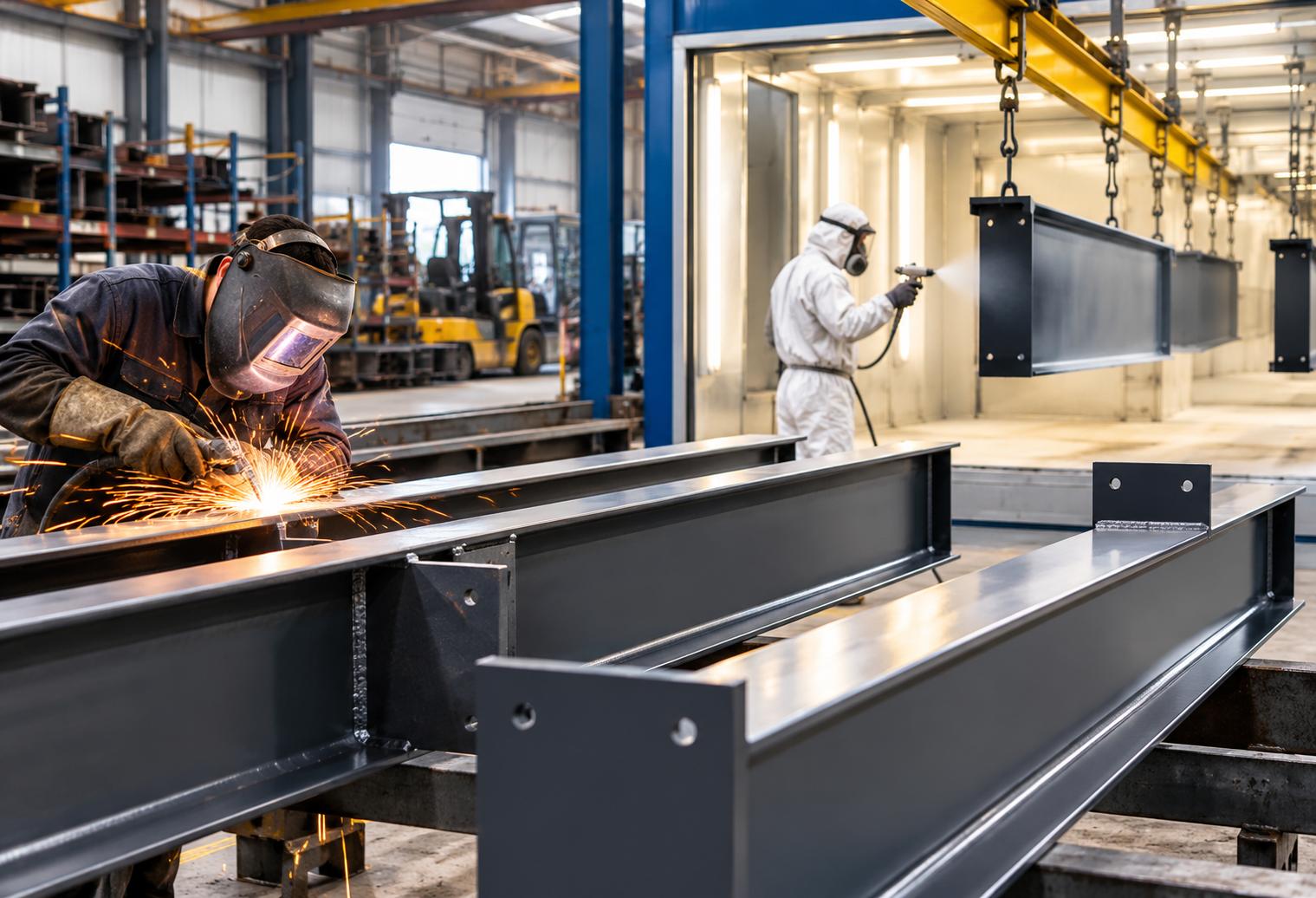
For a steel fabrication shop, finishing is not just the last step before delivery. It can determine whether a completed fabrication leaves the shop on schedule or becomes the reason a customer is waiting. Around Auburn and southern New Hampshire, that matters for fabricators serving construction, industrial, commercial, and equipment-related projects where multiple schedules often depend on one another.
Quick answer: Steel fabrication shops need a painting partner who understands turnaround time because coating has to fit into the larger production schedule. A dependable painting process requires coordination around part readiness, surface condition, coating requirements, handling, curing, and pickup or delivery. When those pieces are planned together, fabricators have a better chance of keeping finished steel moving instead of creating a bottleneck at the coating stage.
What local fabrication shops should know
-
Turnaround time should be discussed before fabricated parts are ready for coating, not when a deadline is already approaching.
-
Rockingham County and the greater Manchester area are part of a substantial New Hampshire manufacturing economy, making reliable coordination between specialty vendors especially relevant.
-
New Hampshire’s seasonal temperature and moisture changes can affect how fabricated steel is stored, transported, and prepared before finishing.
-
Rush work can create problems when coating requirements, quantities, dimensions, or scheduling expectations are not communicated early.
-
A painting partner should understand that a fabricator’s deadline may also affect installers, contractors, equipment builders, and the end customer.
Why Does Painting Turnaround Matter to Auburn Steel Fabricators?
Painting turnaround matters to Auburn steel fabricators because finishing is often part of a larger production chain, and a delay at the coating stage can hold up work that is otherwise ready to ship. Fabrication, finishing, transportation, installation, and customer deadlines need to work together rather than operate as isolated schedules.
New Hampshire has a meaningful manufacturing base. New Hampshire Employment Security reported that manufacturing accounted for 11.7 percent of private-sector employment statewide in 2023. Rockingham County alone had 16,613 manufacturing workers that year.
Auburn is in Rockingham County and is also identified with the Manchester labor market area, placing local shops within a broader southern New Hampshire business and manufacturing network. Fabricators in and around Auburn may be coordinating work headed toward Manchester, Londonderry, Derry, Hooksett, Bedford, or other communities across the region.
ARC Electrostatic Painting understands that painting is one step within that larger workflow. When we discuss a fabrication project, turnaround expectations deserve attention alongside the coating itself.
What Do Local Manufacturing Data Tell Us?
Local manufacturing data show that fabrication and related manufacturing remain significant parts of New Hampshire’s economy, which makes dependable specialty-service scheduling relevant to area producers. State labor data also show that fabricated metal product manufacturing represents a substantial portion of New Hampshire manufacturing employment.
New Hampshire Employment Security’s short-term industry projections estimated 11,576 jobs in fabricated metal product manufacturing in the second quarter of 2023. The agency projected 11,667 jobs in the sector by the second quarter of 2025.
For fabrication shops, those numbers provide useful regional context. Painting is not occurring in isolation. It supports an active network of manufacturers producing components, assemblies, equipment, structural items, and other fabricated products.
From a practical workflow perspective, the most productive coating relationships begin with communication. Knowing quantities, sizes, coating specifications, desired completion dates, and handling requirements before material arrives makes realistic scheduling easier.
How Can Slow Painting Affect a Fabrication Shop?
Slow painting can affect a fabrication shop by extending work-in-process time, occupying valuable floor or storage space, complicating transportation, and putting downstream schedules under pressure. A finished weldment is not necessarily a finished order if coating is still required before the customer can receive or install it.
The consequences can extend beyond one purchase order. Parts waiting for finishing may compete for staging space. Trucks may need to be rescheduled. Installation crews may be working toward dates established before fabrication began.
For shops serving customers throughout southern New Hampshire, coordination also involves transportation. A coating schedule should account for when pieces can leave the fabrication facility, when they can be processed, and when they will be ready for their next destination.
What Warning Signs Suggest Your Painting Process Is Becoming a Bottleneck?
A painting process may be becoming a bottleneck when completed fabrications repeatedly wait for coating, scheduling information is unclear, or your team has to chase updates before it can plan shipping. These issues are especially worth addressing when painted steel is a regular part of your production mix.
Watch for:
-
Finished steel regularly sitting in staging while waiting for painting.
-
Uncertainty about when completed parts will return.
-
Repeated last-minute requests for rush finishing.
-
Production employees spending significant time coordinating coating logistics.
-
Shipping dates being set before finishing requirements are confirmed.
-
Coating specifications reaching the painter late in the process.
-
Large batches accumulating because finishing was not scheduled alongside fabrication.
One occurrence does not necessarily indicate a larger problem. Repeated occurrences suggest that finishing needs to be treated as part of production planning rather than as an afterthought.
When Should a Fabricator Contact a Professional Painting Partner?
A fabricator should contact a professional painting partner before the job reaches the end of fabrication when coating is part of the customer’s specification or delivery requirement. Early communication gives both shops more opportunity to identify scheduling, preparation, handling, and coating considerations before they affect the promised completion date.
A shop can safely handle its own internal production planning, drawings, fabrication sequence, and customer communication. Professional coating work becomes relevant when the project requires a finishing process that the fabrication shop does not perform efficiently or does not want consuming its own production capacity.
For Auburn-area projects, early coordination can be particularly useful during busy construction and manufacturing periods when multiple suppliers may be working toward the same installation date.
What Common Factors Cause Finishing Delays?
The most common finishing delays come from scheduling gaps, incomplete project information, surface-condition issues, handling complications, and unrealistic timing expectations. Fabricators can reduce many of these problems by treating coating requirements as production information that should be established before parts leave the shop.
Late scheduling: Waiting until fabrication is complete to find finishing capacity can make the painter the unintended critical path.
Incomplete specifications: Color, coating requirements, quantity, dimensions, and desired completion timing should be clear before work begins.
Unexpected surface conditions: The condition of incoming steel can influence what needs to happen before a coating is applied.
Batch changes: A job that grows significantly after scheduling may require more processing time than originally anticipated.
Transportation and handling: Large, heavy, or awkward fabrications require planning beyond the actual application of paint.
New Hampshire’s changing seasons add another practical consideration. Steel moving between shops around Rockingham County and the Manchester area can encounter rain, snow, road moisture, humidity, and winter conditions, making proper handling and scheduling worthwhile.
How Can Fabricators Prevent Painting From Slowing Production?
Fabricators can prevent painting from slowing production by involving their coating partner early, providing complete job information, and building finishing into the production schedule from the beginning. The goal is not simply to request the fastest possible completion date. It is to create a realistic workflow everyone can plan around.
Before sending a job out, confirm the quantity and dimensions of the pieces, coating requirements, color requirements, expected fabrication completion date, desired return date, and any special handling considerations.
Seasonally, southern New Hampshire shops should also think ahead. Winter transportation around Auburn, Manchester, Londonderry, and Hooksett can introduce different handling considerations than a dry summer day. Planning transportation and storage along with coating reduces unnecessary surprises.
DIY painting may make sense for certain shop needs, but once finishing becomes a recurring production requirement, the labor, space, equipment, preparation, and scheduling involved should be evaluated against using a dedicated painting partner.
What Should You Expect From a Well-Coordinated Painting Process?
A well-coordinated painting process should give a fabrication shop clearer expectations about scheduling, job requirements, and the movement of parts through finishing. It should support the shop’s production workflow rather than force the fabricator to repeatedly reorganize around uncertain completion dates.
That does not mean every job can or should have the same turnaround time. A small batch of straightforward components and a large collection of complex fabricated assemblies can involve very different requirements.
The better expectation is communication. Your painting partner should understand the requested schedule, evaluate the actual scope, and help establish realistic expectations before the job becomes urgent.
What Mistakes Create Unnecessary Turnaround Problems?
Turnaround problems often start with treating painting as a last-minute purchase instead of a scheduled production operation. For Auburn-area fabricators, the better approach is to coordinate finishing with the same attention given to material ordering, cutting, welding, machining, and shipping.
Mistake: Waiting until the job is complete to schedule painting.
Consequence: Finishing capacity may not align with the customer’s delivery date.
Better approach: Discuss the expected painting window while fabrication is still underway.
Mistake: Sending incomplete coating information.
Consequence: Questions can interrupt processing.
Better approach: Confirm specifications and project requirements beforehand.
Mistake: Assuming every project requires identical turnaround.
Consequence: Production promises may be based on unrealistic assumptions.
Better approach: Schedule according to the actual size, quantity, configuration, and finishing requirements.
What Does a Common Auburn-Area Fabrication Scenario Look Like?
A common Auburn-area scenario involves a fabrication shop completing steel components on schedule only to discover that finishing has become the final scheduling constraint. This is a representative scenario, not a specific ARC Electrostatic Painting customer project.
Imagine a shop fabricating a group of steel components for a commercial project in the greater Manchester area. Welding is nearly complete, transportation is being planned, and the customer has an expected installation window.
If painting is first discussed at that point, the fabricator has little scheduling flexibility. If the coating partner was contacted earlier, the expected completion window, job size, and finishing requirements could already be part of the production plan.
That difference is why turnaround awareness matters.
How Can Professional Painting Support Steel Fabrication Production?
Professional painting can support steel fabrication production by moving specialized finishing work outside the fabrication shop while keeping coating requirements connected to the overall schedule. This can help fabricators focus their internal resources on the work their production floor is designed to perform.
For suitable projects, electrostatic painting is one professional finishing option. The appropriate process depends on the fabricated item, surface, coating requirements, intended use, and project specifications.
We can discuss those requirements with fabrication shops that need painting support and help establish expectations before work is scheduled.
How Should Fabricators Compare In-House Painting With a Painting Partner?
Fabricators should compare in-house painting with professional outsourced painting based on capacity, equipment, labor, quality requirements, scheduling, handling, and the frequency of finishing work. The least disruptive option is often more valuable operationally than simply comparing one line-item price.
In-house work gives the fabrication shop direct control over scheduling but also requires space, employee time, equipment, preparation, materials, and process management.
An outside painting partner moves those responsibilities to a dedicated provider, but communication becomes essential. The outside shop needs accurate information and enough lead time to coordinate its production schedule with yours.
The right choice depends on the project and the fabrication shop’s capabilities.
What Areas Can Local Fabricators Coordinate From?
Local fabricators can coordinate painting projects from Auburn and throughout the surrounding southern New Hampshire region, subject to project requirements and service availability. Auburn sits in Rockingham County within the Manchester labor market area, with communities such as Manchester, Londonderry, Derry, Hooksett, Bedford, and Chester nearby.
For specific service availability outside Auburn, confirm the project location and requirements directly with us.
What Can It Cost to Ignore Finishing Lead Time?
Ignoring finishing lead time can cost a fabrication shop schedule flexibility, production space, administrative time, and potentially the ability to meet a planned delivery window. The greatest risk is often not painting itself, but discovering too late that the finishing schedule does not match the rest of the job.
A delayed painted component can affect trucking, staging, installation, or another contractor’s work. That is why the safest approach is straightforward: identify finishing requirements early and include them in production planning.
FAQ
How early should an Auburn fabrication shop schedule painting?
An Auburn fabrication shop should discuss painting as soon as the coating requirements and approximate production schedule are known. The exact lead time will depend on job size, piece configuration, surface condition, coating requirements, and current scheduling. Earlier communication generally provides more room to coordinate fabrication, finishing, transportation, and delivery.
Why is turnaround time important for New Hampshire steel fabricators?
Turnaround time is important because coating may sit between fabrication and final delivery or installation. New Hampshire has a significant manufacturing sector, including fabricated metal product manufacturing, so specialty processes often need to fit within broader production schedules. A predictable finishing plan helps shops coordinate their own work and downstream commitments.
Can winter weather affect painting logistics around Auburn?
Winter weather can affect the logistics surrounding a painting project, particularly transportation, storage, and the condition of steel moving between facilities. Fabricators in Auburn and the Manchester area should consider snow, road moisture, precipitation, and temperature changes when planning how fabricated items will be stored and transported before and after professional finishing.
Should a fabricator wait until welding is complete before calling a painter?
No, a fabricator does not necessarily need to wait until welding is complete before discussing the project with a painter. Early scheduling can establish expected quantities, dimensions, specifications, and timing while fabrication is still underway. Final readiness will depend on the project, but planning ahead can reduce last-minute scheduling pressure.
Does every fabricated steel project have the same painting turnaround?
No, painting turnaround can vary according to the actual project requirements. Quantity, component dimensions, geometry, surface condition, coating specifications, handling requirements, and the painting shop’s existing schedule can all matter. Fabricators should obtain project-specific scheduling information rather than building production plans around an assumed standard turnaround.
Why does Rockingham County’s manufacturing base matter to fabrication shops?
Rockingham County’s manufacturing base shows that local fabricators operate within an active regional production economy. New Hampshire Employment Security reported 16,613 manufacturing workers in Rockingham County in 2023. That context reinforces the value of coordination among manufacturers and specialty service providers supporting production throughout southern New Hampshire.
Can a painting partner help reduce fabrication shop bottlenecks?
A painting partner can help reduce a finishing bottleneck when work is scheduled and coordinated effectively. Outsourcing appropriate painting work may keep specialized finishing from consuming internal fabrication resources, but results still depend on communication, realistic scheduling, accurate specifications, and ensuring parts are ready when expected.
What information should I provide before scheduling steel painting near Manchester?
Provide the project quantity, approximate dimensions, coating requirements, color requirements, anticipated fabrication completion date, desired return date, and relevant handling information. For projects moving between Auburn and the greater Manchester area, discussing transportation timing can also help ensure the finishing schedule fits the larger production and delivery plan.
Keep Fabricated Steel Moving on Schedule
A good finishing relationship is about more than applying paint. For fabrication shops around Auburn and southern New Hampshire, it is about coordinating coating with production so completed steel can keep moving toward delivery.
We work with customers to understand project requirements and scheduling expectations before the painting process begins.
Build Painting Into Your Production Schedule
Give your next fabricated steel project a better-planned path from the shop floor to final delivery. Contact ARC Electrostatic Painting to discuss your painting requirements, timing, and project details.